What spoon should you use for caviar, and why not a metal one?
Short answer
Caviar spoons are traditionally made of mother-of-pearl (nacre), the shiny inner layer of mollusc shells. Mother-of-pearl, horn, bone, wood, glass, gold and even plastic are all taste-neutral. The one to avoid is silver: it reacts with salty caviar and leaves a metallic taste. A plain stainless steel spoon will do in a pinch, but mother-of-pearl remains the classic choice.
Whether you are new to caviar, looking for the answer to your crossword clue, or simply curious about these peculiar spoons, we've got you covered.
If you're here to solve your crossword puzzle, let us save you some time. The answer is usually NACRE, but it can also be NACRES, PEARL or MOTHER-OF-PEARL.
In this guide, we explore the subject of caviar spoons: which are best and recommended, and which aren't. Read on to learn more.
In This Guide
What is a Caviar Spoon Made Of?
Caviar is an expensive delicacy that is traditionally enjoyed with spoons that you do not see every day.
They are small and particular, with a mysterious, iridescent and marbled appearance.
Typically, a caviar spoon is made of nacre, the same material as pearls. This is why nacre is also referred to as mother-of-pearl.
However, caviar is also enjoyed with spoons made of horn, bone, wood, glass, gold and even plastic, albeit not as frequently.

But now you may wonder, why do we use a pearl spoon to eat caviar? Why not a metal spoon? Because of science and gastronomy.
Nacre, gold, horn, wood, glass and plastic are all neutral materials: they do not react with the caviar or add a taste of their own.
Some metals, on the other hand, especially silver, react with salty caviar and distort its taste. This is important because caviar is so special and expensive that enjoyers do not want to disrupt its tastes and flavours, not even marginally.
Why Is Caviar Eaten With a Mother-of-Pearl Spoon?
Short answer
Caviar is eaten with a mother-of-pearl spoon because nacre is completely neutral: it adds no taste, smell or temperature of its own, so you taste only the caviar. It also avoids a real problem: silver spoons, once common at elegant tables, give salty caviar an unpleasant metallic tang.
Mother-of-pearl is also smooth and gentle on the delicate eggs, so they slide off the spoon without being crushed. And, let's be honest, its pearly shine is part of the ritual.
Metal Spoons: The Forbidden Ones
Silver, silver plate, copper and aluminum are a big no-no when it comes to serving and eating caviar.
Silver is the real culprit. When America's Test Kitchen tasted the same caviar from plastic, mother-of-pearl, silver and stainless steel spoons, only the silver spoon spoiled it, leaving the caviar "acrid, metallic, and acidic". Their science editor explains that silver touching the tongue can create a mild electrical current that we perceive as a coppery, metallic taste, and salt makes that current flow more easily.
What about stainless steel? In the same test, caviar eaten from a stainless steel spoon tasted perfectly good. So if a stainless steel spoon is all you have, you won't ruin your caviar. Connoisseurs still prefer a non-metal spoon, and many serve caviar in glass or crystal rather than a metal bowl.
Remember, caviar is very delicate, complex and sensitive, so using the recommended utensils makes a difference. Read on to learn what those are.
Different Kinds of Caviar Spoons
If you've made it this far, you're probably wondering what kind of spoon you should use for caviar.
While there are a number of choices, we recommend mother-of-pearl caviar spoons. They are perfect for the job, easy to care for and inexpensive. Here is how the main types of caviar spoons compare:
| Material | Taste-neutral? | Durability | Cost |
|---|---|---|---|
| Mother-of-pearl (nacre) | Yes | Good, but avoid knocks | Low to moderate |
| Horn | Yes | Very sturdy | Low to moderate |
| Bone | Yes | Sturdy | Low to moderate |
| Wood | Yes, if well finished | Good | Low |
| Glass | Yes | Fragile | Low to moderate |
| Plastic | Yes | Good | Very low |
| Gold or gold-plated | Yes | Excellent | High to very high |
| Stainless steel | Mostly | Excellent | Low |
| Silver | No | Excellent | Moderate to high |
Mother of Pearl (Nacre) Caviar Spoon
The most common type of caviar spoon is made of nacre, the inner lining of mollusc shells. This material is also referred to as mother-of-pearl because it's the same substance pearls are naturally made from.
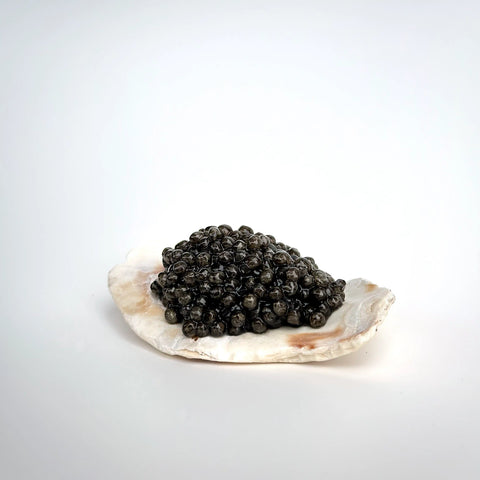
Nacre is the inner shell layer of molluscs such as clams, oysters, mussels and abalone, as pictured below. It is made mostly of tiny plates of calcium carbonate bound together by proteins, which gives it its strength and its rainbow shimmer.
It is shiny and smooth, with iridescent colours that make it quite intriguing, and a beautiful marbled appearance.

Mother-of-pearl caviar spoons are also referred to as shell caviar spoons, shellfish caviar spoons and oyster caviar spoons. All three refer to spoons made of nacre.
Wood Caviar Spoon
Wood is another popular material for caviar spoons. This naturally rustic material is perfectly acceptable and won't tamper with the taste of caviar.
Make sure to use a wooden spoon with a quality finish; otherwise, it may leave a slightly dry and earthy flavour. A low-quality wooden caviar spoon will also be absorbent and retain flavours between uses.
Gold Caviar Spoon
Gold is a metal famous for its scarcity as well as its many interesting properties. One of these properties is that gold is very unreactive, which is the key to a great caviar spoon.
Gold caviar spoons are not as common because of how expensive they are, but they are a great option. Many makers now offer gold-plated spoons, or spoons with just a gold bowl, to make them more affordable.
Animal Horn Caviar Spoon
Animal horns were once the plastic of their time: horn can be heated and moulded into all kinds of shapes.
Cattle, buffalo and sheep horns are used to make horn caviar spoons.
Although not the most popular option, horn is a great one, thanks to its texture and sturdiness. The material is also very beautiful and has been used to make art and jewellery for centuries.
Plastic Caviar Spoon
Can you eat caviar with a plastic spoon? Surprisingly, yes (who would have thought?).
Although not at the top of the recommendation list, plastic spoons are often used at parties and tastings. They are cheap, and plastic does not affect the flavour of sturgeon caviar: in America's Test Kitchen's test, caviar from a plastic spoon tasted perfectly good.
Glass Caviar Spoon
Glass is another perfectly acceptable material to serve and eat caviar with, although it is not very common.
It does not affect the taste of caviar, but it is quite fragile.
Ivory & Bone Caviar Spoon
Bone and ivory have been used for centuries to make tools, art and jewellery, and both are taste-neutral, which made them classic materials for caviar spoons.
Today, ivory is off the table: international trade in African elephant ivory has been banned under CITES since 1989, so new ivory spoons are not an option. Bone spoons, on the other hand, are a legal, taste-neutral alternative with a similar look.
Marble Caviar Spoon
Marble caviar spoons don't really exist. Many people confuse mother-of-pearl spoons with marble because of their similar appearance.
In theory, marble spoons could be used to enjoy caviar.
Best Size for Caviar Spoons
Caviar spoons come in a small range of sizes, from about 5 cm (2 in) to 12 cm (4.75 in).
The most common sizes are approximately 7 cm, 10 cm and 12 cm; our mother-of-pearl spoon, for example, is about 10 cm long. For reference, a regular teaspoon is a little longer.
That being said, the best size of caviar spoon depends on your personal preference, the amount you are eating, and how you are eating it: a small spoon is ideal for tasting straight from the tin, while a longer one is handy for serving.
Best Caviar Spoon Shape
Caviar spoons come in two styles: the classic shallow spoon and the paddle.
The spoons are what you typically see being used and sold. They are short, with a shallow bowl at the end.
Paddles are considered a bit more fancy and luxurious, and are typically about twice as long as an average caviar spoon.
Practically speaking, the classic spoon with a shallow bowl is the best caviar spoon shape.
Caviar Spoon Prices
Caviar spoons are generally inexpensive, with the exception of gold spoons.
A good mother-of-pearl spoon is very affordable: ours costs $14.99 CAD for a single 10 cm spoon. Horn, bone, wood and glass spoons sit in a similar range, and plastic tasting spoons cost just a few cents each.
Gold spoon prices can vary greatly, as they can be anything from gold-plated to solid gold.
If you're looking to break the bank, have a look at one of the most extravagant caviar spoons ever made: the "Dragon Spoon" by jeweller Paul Amey, crafted in 18K gold and platinum and set with more than 180 diamonds.

Other Caviar Utensils
A spoon is all you really need, but a few other caviar utensils make serving easier and more elegant:
- A tin opener: caviar tins are sealed tight, and a caviar tin opener lifts the lid without bending it or spilling the eggs.
- A bowl of crushed ice: caviar is best served very cold, so set the tin on ice. A glass or crystal server works best.
- A serving spoon: a longer spoon or paddle lets guests help themselves without touching the caviar with their tasting spoon.
Everything you need in one box
Our First Experience set includes Siberian caviar, blinis, crème fraîche and serving tools. Browse all our caviar accessories.
Frequently Asked Questions
What spoon do you use for caviar?
Traditionally, a mother-of-pearl (nacre) spoon. Horn, bone, wood, glass, gold and plastic spoons also work, because they don't affect the taste. Avoid silver.
Why do you eat caviar with a pearl spoon?
Because mother-of-pearl is completely neutral: it adds no metallic taste, so you taste only the caviar. Silver spoons, once common, give salty caviar an unpleasant metallic tang.
Can you eat caviar with a metal spoon?
Avoid silver, which makes caviar taste metallic. Stainless steel is far less of a problem: in a blind test by America's Test Kitchen, caviar from a stainless steel spoon tasted fine. A non-metal spoon is still the classic choice.
Can you use a plastic spoon for caviar?
Yes. Plastic doesn't affect the taste of caviar, which is why plastic spoons are common at tastings and parties.
What is a caviar spoon called?
Usually a mother-of-pearl spoon or nacre spoon. In crosswords, the answer is often NACRE.
What size is a caviar spoon?
Most are about 7 to 12 cm (3 to 4.75 in) long, a little shorter than a regular teaspoon.
How much is a spoon of caviar?
A small spoonful of about 5 g of sturgeon caviar costs roughly $16 to $39 CAD, based on typical Canadian prices of about $90 to $220 for a 28 g tin. See our caviar price guide.
Where can I buy a caviar spoon in Canada?
You can buy our mother-of-pearl caviar spoon online, shipped across Canada with your caviar or on its own.
Key Takeaways
- Caviar is best enjoyed with spoons made of neutral materials that don't affect its taste.
- Mother-of-pearl (nacre) is the classic, recommended type of caviar spoon.
- Silver spoons are not advisable, as they give caviar a metallic taste; stainless steel is acceptable in a pinch.
- Caviar can also be enjoyed with horn, bone, wood, glass, gold and plastic spoons.
- The typical size of a caviar spoon is about 7 to 12 cm.
- A good mother-of-pearl caviar spoon costs about $15.
This guide was reviewed by CaviarHub and updated in October 2026. Taste findings come from America's Test Kitchen, nacre science from the Royal Society of Chemistry, and prices and spoon specifications from CaviarHub.
Sources & References
- • CaviarHub research: spoon specifications and prices (October 2026)
- • Do You Really Need a Mother-of-Pearl Spoon to Eat Caviar or Roe? – America's Test Kitchen
- • Hierarchical structure and mechanical properties of nacre: a review – Royal Society of Chemistry, RSC Advances, 2012
- • Static and dynamic mechanical properties of cattle horns – Materials Science and Engineering: C
- • Ban on African elephant ivory – Environment & Society Portal, Rachel Carson Center
- • Paul Amey 18K and Diamond Caviar "Dragon Spoon" – 1stDibs